"You can't put a limit to anything. The more you dream, the farther you'll get." is the aphorism I picked by Michael Phelps. I believe this quote reflects in Joseph Campbell's idea of the hero's journey in many ways. Joseph says that the ones a hero when your life starts, for it is a great fight when the baby is born, and when that happens the baby has outdone himself. When you think of a hero, you think of a person that never gives up, always saves the day, and succeeds every time. This quote gives the idea of never giving up, and always fighting, so no matter how many obstacles you need to pass for success, you should never give up. The hero needs to be ready for that new success he/she is visualizing in his/her life. Saying this, the first part of the quote, where Michael says you can't put a limit to anything, I believe it means that the hero needs a very big idea of what he can achieve. Looking beyond what he believes he/she cannot do.
The quote can inspire people to do everything. Because if people don't look forward to their dreams or goals in life, they will never actually succeed. People need to fight for what they want, and thats is why "the more you dream, the farther you'll get" because if you dream of success you will eventually achieve it.
Tuesday, May 28, 2013

Thursday, May 16, 2013
Aphorism
The aphorism I selected is a quote by Michael Phelps. "You can't
put a limit on anything. The more you dream, the farther you get."
I found this quote in this website
I selected this one because it was in the sports
section, and I believe sports takes up to 80% of my life. Although it is a
little cliché, but I can still relate to what he was trying to say.
This quote made me think a lot of myself. I love sprots, and I have
always been a very sporty person. I like to move and exercise my
body. I have been in the school gymnastics team for almost 11 years. I've been
always under a lot of pressure and I have thought of giving up. But as the
quotes says, the more you think about it, and fight for what you want, the more
you will achieve. I agree with this feeling because it is true, every time you
think and be positive about something, you will do it. When I am in gymnastics
in a competition and I feel like I can't do anything else, and think
of giving up, I just imagine me being successful
and achieving what I want, and that positive thinking and attitude
gives me strength to keep on fighting. Also when I run, I think and
believe I'm not tired, even thought I've been running for an hour. Like the
quote says, you can't place a limit, because you can achieve
practically anything you are up to achieve. I believe people just
have to believe in themselves and keep giving more of them each time.
I feel this should be the "motto" of life, because with this people
can do whatever they want, and will be successful. I feel that this quote and
that believe, have made the athlete I am now. Because I never gave up, I always
kept on thinking on the great things I could be doing in the future, and what
would I lose if I gave up.
Monday, April 29, 2013
Section 4
Section 4 i find it the most important and the one that teaches the most. After Kamala's death, Siddhartha tries his best to bond with his son. He is still sad because of his mother, he doesn't understand what happened and how it will ever be fine. Siddhartha wants to teach his son most of his knowledge, so he as his father, can understand things. But he is reminded that he could never pass his knowledge though his son had to experience it all. He had to experience to be able to understand everything Siddhartha understood. The son runs away through the river. Siddhartha and Vesudeva try to find him but they can't. Siddhartha goes to the town but gives up, because he knows he will never find him. SIddhartha feels hurt and sad for waht his son did. He keeps on learning from the river and Vesudeva, who know is seen holy and as a god to Siddhartha. One day Versudeva tells Siddhartha he need to listen to river, he hears all the voices togteher and feel an eternal peace and unity to the world. Siddhartha had finally achieved enlightenment. Versudeva confesses he wants to leave and wander through the world, so he can find his own inner peace. He leaves Siddhartha as the ferryman, and disappears into the forest. Govinda is still a monk, but he has been notified that there was a very wise and holy ferryman. He goes and visits this ferryman without knowing it was Siddhartha. They discuss and he finally knows it was his good friend. Before Govinda leaves, Siddhartha asks him to kiss him in the forehead. WHen this happens Govinda watches Siddhartha's entire live through his eyes, all the faces, the suffering and happiness. When he steps back he feels a need to worship and venerate Siddhartha.
This section can give the reader many emotions. Siddhartha finally found illumination an a perfect balance between his life and the whole universe. He found what he was looking for, and could share it with his dearest friend Govinda. But the end of the book also gave me a lot of questions. What happens to Govinda after this experience? Will he try to achieve illumination? What will happen to Siddhartha? How come people learn from him, if he couldn't teach his knowledge? The end of the book made me a little emotional. Govinda felt the need to look up to Siddhartha, I feel the same for my big brother. Without him I would never be the person I am right now. I would had never fallen into the path of Buddhism, or see things as I see them right now. I would feel part of the society that know rules the world. Without my brother I believe I wouldn't feel as proud of myself and my actions as I am now.
This section can give the reader many emotions. Siddhartha finally found illumination an a perfect balance between his life and the whole universe. He found what he was looking for, and could share it with his dearest friend Govinda. But the end of the book also gave me a lot of questions. What happens to Govinda after this experience? Will he try to achieve illumination? What will happen to Siddhartha? How come people learn from him, if he couldn't teach his knowledge? The end of the book made me a little emotional. Govinda felt the need to look up to Siddhartha, I feel the same for my big brother. Without him I would never be the person I am right now. I would had never fallen into the path of Buddhism, or see things as I see them right now. I would feel part of the society that know rules the world. Without my brother I believe I wouldn't feel as proud of myself and my actions as I am now.
Section 3
This section answered a lot of questions that were in my head. It explained a lot of Siddhartha's life and what he was going through. Siddhartha learned to be a business man, but saw his job as a game, for he was not interested in wealth. He saw normal problems in other people he found insignificant to life. He still had his ideal of a Samana. Kamala his lover, made him feel understood like no body else could. They shared a kind of love that was no common, but they both knew they could never love each other the way other could love. After a year of being a merchant Siddhartha starts to gamble, and his ideal start to fade. He has a strange dream in which he realizes and feels all his goodness is gone. He decides to leave his treasures and seek for the peaceful life he had. He doesn't say goodbye to Kamala, he just disappears, and without knowing Kamala is pregnant with his child. Siddhartha comes to the thought of suicide, he feels lonely, and depressed. While wondering through the forest, Siddhartha arrived to the river he had once passed, and reunites with Vasudeva, the ferryman he had met years before. He stays with him and learns from the river, and regains that peace he had once had within him. Govinda and Siddhartha come back together and talk, but Govinda is still a monk. He leaves Siddhartha, which know know that Gotama is sick and will eventually die. Kamala starts to follow the Buddha's steps with her son, and while trying to find him, she is bitten by a snake. Kamala is helped by Vasudeva and Siddhartha. Kamala is dies, and Siddhartha is left with his son.
This section made me think a lot because there are a lot of things that were left hanging. What will happen to Siddhartha and his son? Will Siddhartha reunite with govinda and Gotama once again? Will he stay with Vasudeva and keep on learning from the river? When will he become illuminated? All this questions came right to my mind when I read this couple of chapters. I felt in disagreement when Siddhartha thinks he had to suffer to achieve happiness and knowledge. Why would you have to suffer to achieve happiness, greatness or knowledge? Not everyone has to follow those steps. I certainly believe this is false, and why would you have to experience richness or wealth to understand they are not important. Those two ideals or believes make no sense to me. I believe that with effort you can do anything with out suffering or experiencing things.
This section made me think a lot because there are a lot of things that were left hanging. What will happen to Siddhartha and his son? Will Siddhartha reunite with govinda and Gotama once again? Will he stay with Vasudeva and keep on learning from the river? When will he become illuminated? All this questions came right to my mind when I read this couple of chapters. I felt in disagreement when Siddhartha thinks he had to suffer to achieve happiness and knowledge. Why would you have to suffer to achieve happiness, greatness or knowledge? Not everyone has to follow those steps. I certainly believe this is false, and why would you have to experience richness or wealth to understand they are not important. Those two ideals or believes make no sense to me. I believe that with effort you can do anything with out suffering or experiencing things.
Tuesday, April 16, 2013
Siddhartha blogposts I and II
Blogpost I : Section 1
I really can connect with this book, because of my beliefs, I like the way the author explains the story. I as Siddhartha in the section follow the teachings, and try to find a way to "illumination". I try to follow his steps, not to become the next Buddha, but the way he saw life and learn how to appreciate every second of it. I believe as the Bible the story of Siddhartha has many perspectives and many ways to interpret it. I believe this because this version of the story add things I had never seen before, and lacks of other things. But still I think it is because of the author telling the story. I haven't gone from my house to seek for knowledge, but I have attended classes and retreats. In this retreats I have heard the teachings of Buddha and many other illustrious men and women. This teachings help other beginners like me to start their path to live the life they are seeking for. I have really learned a lot of this "classes"like Buddha learned from the Samanas and the elders. What will happen to Sidhhartha now that he started his journey? Will he find what he is looking for? Will he motivate people to follow his teachings?
Blogpost II: Section 2
The more I read this book the more I find it similar to other books of the Buddha. For example the book "El Budacrita" is a book about the life of Buddha, in spanish. They are similar because the words they use and the story is mostly the same, except some little details, as I said due to perspective. I also read another book long ago I don't remember the name that was practically the same to this one we are reading. This book reminds me of the movie "Spirited Away" they have totally different topics, but I made a rare connection. In the movie Chihiro (the main character) enters a world of fantasy, in which she has to work and win her parent back. They have been converted into pigs. But I connect to the movie because as Buddha, Chihiro looks by herself how to get out of this strange dream. She keeps with her beliefs, but tries to look at them in another way. When she starts to understand the fantasy world, is like Buddha understanding he doesn't want to follow anyones teachings.
I really can connect with this book, because of my beliefs, I like the way the author explains the story. I as Siddhartha in the section follow the teachings, and try to find a way to "illumination". I try to follow his steps, not to become the next Buddha, but the way he saw life and learn how to appreciate every second of it. I believe as the Bible the story of Siddhartha has many perspectives and many ways to interpret it. I believe this because this version of the story add things I had never seen before, and lacks of other things. But still I think it is because of the author telling the story. I haven't gone from my house to seek for knowledge, but I have attended classes and retreats. In this retreats I have heard the teachings of Buddha and many other illustrious men and women. This teachings help other beginners like me to start their path to live the life they are seeking for. I have really learned a lot of this "classes"like Buddha learned from the Samanas and the elders. What will happen to Sidhhartha now that he started his journey? Will he find what he is looking for? Will he motivate people to follow his teachings?
Blogpost II: Section 2
The more I read this book the more I find it similar to other books of the Buddha. For example the book "El Budacrita" is a book about the life of Buddha, in spanish. They are similar because the words they use and the story is mostly the same, except some little details, as I said due to perspective. I also read another book long ago I don't remember the name that was practically the same to this one we are reading. This book reminds me of the movie "Spirited Away" they have totally different topics, but I made a rare connection. In the movie Chihiro (the main character) enters a world of fantasy, in which she has to work and win her parent back. They have been converted into pigs. But I connect to the movie because as Buddha, Chihiro looks by herself how to get out of this strange dream. She keeps with her beliefs, but tries to look at them in another way. When she starts to understand the fantasy world, is like Buddha understanding he doesn't want to follow anyones teachings.
Monday, February 4, 2013
Visual Examples
1.


This is practically impossible, because if you look carefully both of the hands in the picture are drawing each other. It contradicts itself because it makes you thinking which hand actually started the drawing. It tricks the mind because I believe it shows a cycle, in which each hand will keep on drawing, because none will finish until the other one does. It is also impossible thought that the hands of the drawing are going out of the paper.
2.

This picture is mind teasing, because you can never know for sure which are the legs of the elephant. It is impossible to find the legs. Because if you follow the outline, they will guide you to a space, and if you count you can see up to 9 legs. I think this picture is amazing because every person can interpret it as they wish, and see as many legs as they like. I believe it tries to explain negative spaces, because negative spaces are the gaps from the drawing.
3.
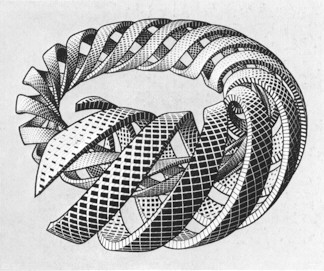
This is a really confusing picture, because the more you look at it the lees you understand it. It starts with a big spiral, which starts to shrink and enters the big one, and then it disappears. I really like this picture, because it shows a cycle like the one of the hands. It never ends and you can keep on looking at it for ever, without ever really understanding it. It contradicts itself, it is big big vs. small.
Thursday, January 17, 2013
Book 4
Reading this book I found this analect very important and a great way for people to think in a better way.
4.17 The master said, “When you see someone who is worthy, concentrate upon becoming their equal; when you see someone who is unworthy, use this opportunity to look within them.
I think Confucius quoted this analect because people judge others with or without knowing them. I find it important because I think judging people is not a good thing. The analect is saying that if you see someone who is faithful, someone that shows respect, that deserves it, or someone who is good, you should follow his steps and become equals. But if you see someone who doesn't deserve trust, effort, attention, or respect, you should place yourself in his or her shoes. I feel like society should use this analect to live a not perfect but better life. I think this because people (including myself) judge other without noticing. I am a Buddhist, so I practice his teachings, and this one is very similar, because you will always feel like judging or talking about someone. But my theory based on my believes and on this analect, is not to judge, because I'm pretty sure that most of the time we judge, is not knowing the whole story.
I truly believe that the world would be so much better without people judging others. We don't know what's happening to them, and it's none of our business. I know it is pretty hard not to do it, but with practice, we can make it better.
Sunday, November 25, 2012
Ethos, Pathos and Logos

This ad uses ethos. It shows Santa Claus drinking Coca-Cola, which makes people want to drink it themselves. Santa Claus is a famous person, who a lot of people respect.

This photo uses logos. Because it gives you a fact about smoking. It shows the hand with a cigarette but the shadow with a gun, this means that you are killing yourself. And for people that smoke the fact about people dying because of smoking is shocking.

This ad uses pathos. Because it is a really shocking and important picture. The photo shows awomen with a cellphone and blood jumping out of it, the ad is meant to "scare" people so they dont use their phones while driving.
Monday, October 22, 2012
Malala Yousafzai
Malala Yousafzai is a girl that was shot lately in the head. She was shot because of her beliefs of fairness in the world. She lives in Mingora, a northwest region of Pakistan. Her hometown was brought under Taliban rule. The Taliban wanted for the religion to be respected and strictly used everywhere. Malala was a brave little girl that wrote a dairy for the BCC Urdu. In this dairy she explained what she thought about all the unfair and forbidden things the Taliban rule was opponing on her town, and the suffering they were facing because o the Taliban rule. The main reason she stood up for her rights was the closing of girls schools. The Taliban's prohibited the education for girls. Malala was shot and people wanted her dead because she respected herself and stood up for her rights.
I think Malala was a very brave girl. Although she knew that exposing her real feelings and thoughts would be bad and dangerous for her and her family, she never gave up. She is supported by her parents who said they preferred having this risk, than the mayor risk of not letting people know about this. She clearly inspired a lot of people, because she was one of the little amount of voices that spoked out, and made people realize what was happening infront of their own eyes. Also her hard work to prove this events to people succeeded, because she was nominated for the International Children's Peace Prize in 2011. And she was awarded the National Peace Award. She indeed was had great bravery and the great independence she had, to do all of this practically alone. I think that what was done to Malala was really wrong, because every person in t he world share the same human rights. As the the list of human rights states:
18. Freedom of belief and thought.
19. Freedom of expression
26. The right for education
This three and probably more rights wer not given to Malala or to the people of her town. This rights were forgotten and they were apart from Malala when she was shot. Although the militants thought this was a lesson for her and for the people that wanted to follow her steps, it wasn't. It was an unfair act. Malala is not the bad one here the Talibans are, and they are making life impossible to so many people that don't deserve it.
List of HUman Rights: http://www.youthforhumanrights.org/
List of HUman Rights: http://www.youthforhumanrights.org/
Tuesday, October 16, 2012
Persepolis
The Veil
In my life, there has been restrictions but never as strict as shown in the book with the veils. I mean I could have family restrictions such as rules, but never rules that implicated how to dress in an obligatory way. This chapter of Persepolis reminds me of a Holocaust book named "Sarah's Key" because at first the Jew kids didn't put attention to the stars the stars sewn on their clothes, they thought it was a game, such as the war. The kids thought it was all a big game, and at the beginning of the book the girls who were required to use the veils thought it was a game.
Persepolis
In a personal experience, I have never suffered hard times, but as a volunteer at homes and very poor towns, you can watch similar behaviors as the book is telling. Were kids told me stories of their parents working for the army, and how they waited for their dads to come back home, how they waited for days even weeks. Kids told me how they saw lots of dead people from wars and wounded soldiers. You can relate this two different stories because in the book Marji waits for her father to come back home from taking pictures of a demonstration. And the part of dead people is how there were dead martyrs from the revolution.
The Sheep
This chapter reminds me of another Holocaust story, it is a movie called the "Pianist", in this movie the main character is looking desperately a way to move away from the city he is living in. He wants to leave everything for a new life, a new start. In the book it says how many families were moving out of Iran. Also it says how they looked for people who could cause problems, tortured them and finally executed them. This relates to the Holocaust too because they gathered Jews or people against the german rule, they captured them, tortured them in concentration camps and then executed them in cruel ways. What will happen to Marji and her family now that war has started? Will they go to follow and start a new life? Or will they fight for the freedom of their country ?
The Passport
This chapter talks about how ill people hadn't a major importance as they should have. I can connect this chapter with my personal life, because when I was little and I had hited myself with a desk so i was bleeding a lot, but in the hospital they weren't paying any attention to my injury, so my parents got really mad. The doctors started talking about random stuff, which didn't help my case, until my parents were taking me somewhere else to help me, they decided to help me closed the opening in my chin. This relates to the chapter because Marji's uncle has a heart attack and the doctors wouldn't give him the help he needed. so Ebi, Marji's dad went to get a false passport to take the man to a place were they could help him. But he died before he even could get hold of the false passport.
The Dowry
In this chapter Marji's parents tell her all the dangers she is exposed when she shows independence and when she fights against the rules. This reminds when my parents thought me the dangers of life, and things I am exposed every day. Then when Marji's parents tell her about how she will move to Vienna. This reminds me when I went for 3 months to France alone, it is not as big as Marji's move, but it must feel the same sadness and loneliness we both felt. Although both situations were for the best, the feelings stay the same. I wonder what will happen to Marji in Vienna? What will happen to her parent? Will they ever catch up with her daughter? What happened to Marji's mom at the airport? Will Marji be happy? And will she succeed away from her parents?
In my life, there has been restrictions but never as strict as shown in the book with the veils. I mean I could have family restrictions such as rules, but never rules that implicated how to dress in an obligatory way. This chapter of Persepolis reminds me of a Holocaust book named "Sarah's Key" because at first the Jew kids didn't put attention to the stars the stars sewn on their clothes, they thought it was a game, such as the war. The kids thought it was all a big game, and at the beginning of the book the girls who were required to use the veils thought it was a game.
Persepolis
In a personal experience, I have never suffered hard times, but as a volunteer at homes and very poor towns, you can watch similar behaviors as the book is telling. Were kids told me stories of their parents working for the army, and how they waited for their dads to come back home, how they waited for days even weeks. Kids told me how they saw lots of dead people from wars and wounded soldiers. You can relate this two different stories because in the book Marji waits for her father to come back home from taking pictures of a demonstration. And the part of dead people is how there were dead martyrs from the revolution.
The Sheep
This chapter reminds me of another Holocaust story, it is a movie called the "Pianist", in this movie the main character is looking desperately a way to move away from the city he is living in. He wants to leave everything for a new life, a new start. In the book it says how many families were moving out of Iran. Also it says how they looked for people who could cause problems, tortured them and finally executed them. This relates to the Holocaust too because they gathered Jews or people against the german rule, they captured them, tortured them in concentration camps and then executed them in cruel ways. What will happen to Marji and her family now that war has started? Will they go to follow and start a new life? Or will they fight for the freedom of their country ?
The Passport
This chapter talks about how ill people hadn't a major importance as they should have. I can connect this chapter with my personal life, because when I was little and I had hited myself with a desk so i was bleeding a lot, but in the hospital they weren't paying any attention to my injury, so my parents got really mad. The doctors started talking about random stuff, which didn't help my case, until my parents were taking me somewhere else to help me, they decided to help me closed the opening in my chin. This relates to the chapter because Marji's uncle has a heart attack and the doctors wouldn't give him the help he needed. so Ebi, Marji's dad went to get a false passport to take the man to a place were they could help him. But he died before he even could get hold of the false passport.
The Dowry
In this chapter Marji's parents tell her all the dangers she is exposed when she shows independence and when she fights against the rules. This reminds when my parents thought me the dangers of life, and things I am exposed every day. Then when Marji's parents tell her about how she will move to Vienna. This reminds me when I went for 3 months to France alone, it is not as big as Marji's move, but it must feel the same sadness and loneliness we both felt. Although both situations were for the best, the feelings stay the same. I wonder what will happen to Marji in Vienna? What will happen to her parent? Will they ever catch up with her daughter? What happened to Marji's mom at the airport? Will Marji be happy? And will she succeed away from her parents?
Monday, September 10, 2012
The Epic of Gilgamesh
Tablet XI
In this tablet Gilgamesh finally arrives to Utnapishtim. Utnapishtim tells Gilgamesh the story of the flood and the reward the gods gave him and his wife of immortality. Utnapishtim explains what happen in those days in the boat in which he freed birds to see if life could "work" after the flood. Then Utnapishtim tells Gilgamesh he has to do a test in which he will show the gods his worth, he will rest for a week. After not accomplished the test, Gilgamesh begins the journey back to Uruk. Utnapishtim tells Gilgamesh a bout a secret of the gods, a secret plant that will help Gilgamesh. In his journey back to Uruk a serpent takes away the plant, so after all the hard work of Gilgamesh and the great journeys were for nothing. When he arrives to Uruk he asks Urshanabi to measure Uruk the city of Gilgamesh.
The end of tablet XI keeps me thinking what will happen to Gilgamesh and to his hard work to accomplish immortality. Will everything will just stay the same? or will the gods will ever reward him?
In this tablet Gilgamesh finally arrives to Utnapishtim. Utnapishtim tells Gilgamesh the story of the flood and the reward the gods gave him and his wife of immortality. Utnapishtim explains what happen in those days in the boat in which he freed birds to see if life could "work" after the flood. Then Utnapishtim tells Gilgamesh he has to do a test in which he will show the gods his worth, he will rest for a week. After not accomplished the test, Gilgamesh begins the journey back to Uruk. Utnapishtim tells Gilgamesh a bout a secret of the gods, a secret plant that will help Gilgamesh. In his journey back to Uruk a serpent takes away the plant, so after all the hard work of Gilgamesh and the great journeys were for nothing. When he arrives to Uruk he asks Urshanabi to measure Uruk the city of Gilgamesh.
The end of tablet XI keeps me thinking what will happen to Gilgamesh and to his hard work to accomplish immortality. Will everything will just stay the same? or will the gods will ever reward him?
Tuesday, September 4, 2012
What happens to us when we die?

I think that when we die, something else happens. I dont think that death is the end of everything, I think reincarnation could be a possible way in which I believe fully. I don't think our body stays were they left it but I do think that another stage of our "life" starts. Maybe reincarnation happens, or people go to Heaven or probably people just die, and nothing happens.
Saturday, September 1, 2012
The Epic of Gilgamesh
Tablets I - III
I really like mythology, and at the beginning of The Epic of Gilgamesh it starts by introducing this hero named Gilgamesh who is the king of Uruk. He created the right for him to sleep to new married brides. The people pleaded to the gods for help, the gods respond to their pleas by creating a similar creature as Gilgamesh named Enkidu in order to distract Gilgamesh. Enkidu was found by a hunter, who gives the notice to Gilgamesh. He decides to seduce this new creature with Shamhat. Enkidu and Gilgamesh have a battle, but after that they become friends. Gilgamesh talks about a journey to the Cedar forest to kill Huwawa so he could regain his total power. Ninsu the mother of Gilgamesh adopts Enkidu as her son.
Tablets IV- V
After traveling a lot Gilgamesh finally gets to Huwawa to kill him. Huwawa tries to convince Gilgamesh to become his servant. But Gilgamesh doesn't accept the offer and kills Huwawa.
Tablets VI - VII
In this part of the epic it shows how "friendship"overcomes love. When the goddess Ishtar is jealous of Enkidu and tries to break their bond. It shows how they can work everything together. But the jealousy of Isthar is so great that she decides that the path that will lead her to success is death. Enkidu dies and Gilgamesh can't do anything about it.
Wednesday, August 22, 2012
Photography Inferences

The moment I saw this picture I was in loved with it. I really gets to your heart and makes you think. It gives you a lot of sad thoughts about what will happen to this little kid and to his father. Also the picture gives you this feeling of shock where you just want to help the people in it. Here are my three inferences:
1. The first thing you can infer from this picture is sadness or pain. You can infer this because of the expression the little boy has on his face, that indeed shoes sadness. Compassion with this little boy who's sad because of this person. It shoes the little kid crying in the arms of this person who could be his father. You can infer that this adult is a soldier, because of his uniform. And that he is going away from his family or seeing them again, which also makes you think of compassion with the soldier.
2. By the picture you can also infer that this adult has a great responsibility, in the case that this person was a soldier. It shoes the responsibility that he has for his country, and for his vocation. You could say the responsibility of the man means he has to leave almost everything apart so he can accomplish his mission. Even his family.
3. Also you could infer that they are going to be apart of each other for a long time, or that they are reuniting from a long time separated. This thoughts could give you nostalgia, thinking that they could have been separated for months, even years, and they can finally see each other again. Or in a bad occasion saying a painful goodbye. Which also shoes the pain and sadness some people live.
Subscribe to:
Posts (Atom)